
What is an Analog Watch?
An analog watch displays time using hands on a dial, a deliberate choice for presence over endless pixels and notifications.
Spectrum Editorial · 6 min read · 31 views
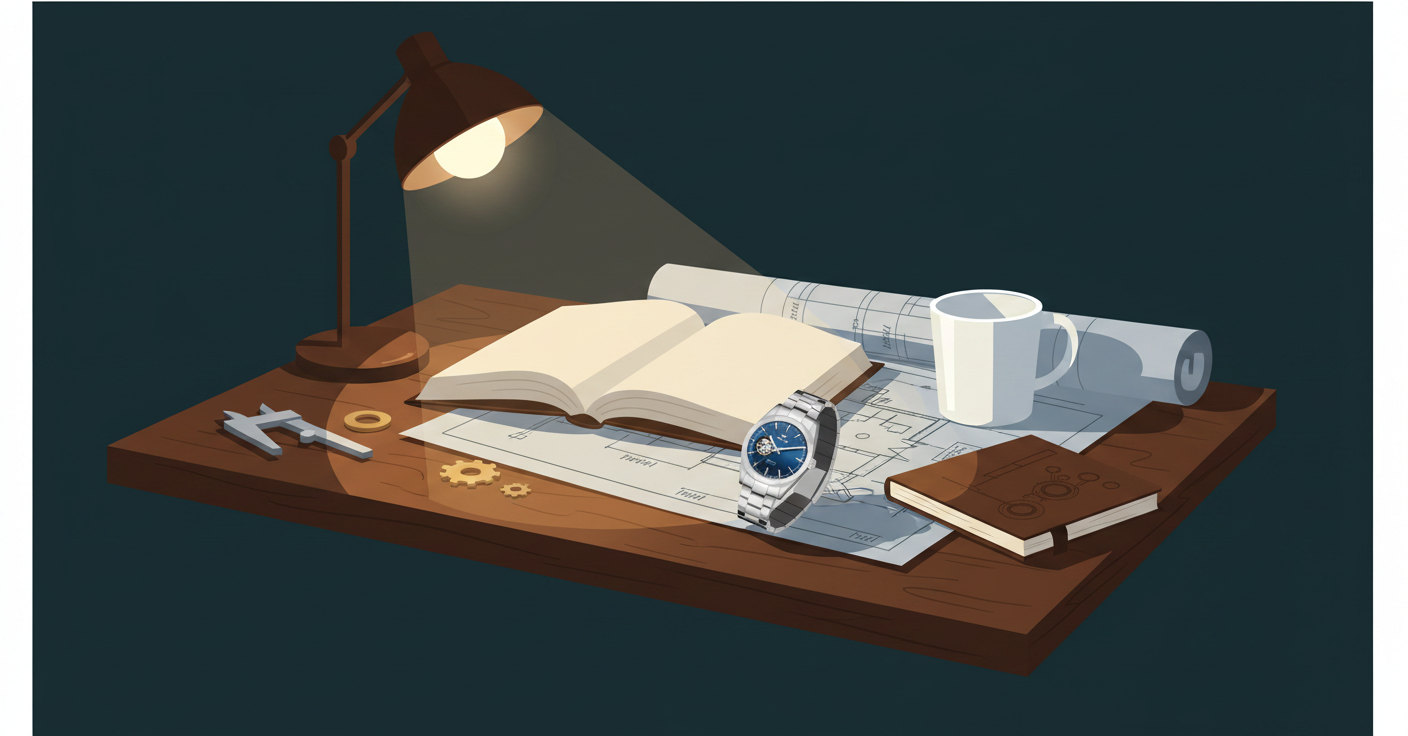
An analog watch displays time through the movement of hands across a numbered or indexed dial, a mechanism powered by either quartz or mechanical movements.
The workshop air hums with the low thrum of a power tool cooling down. You lean back, hands still smelling faintly of cutting oil, watching the dust motes dance in the late-morning sun streaming through the window. There's a half-finished schematic tacked to the wall, a solution still out of reach. The digital display on the bench reads 11:37, a stark, precise number. But a glance down at your wrist, at the steady, sweeping seconds hand of your Spectrum, feels different. It's not just a number; it's a duration, a segment of the arc that is your morning. This distinction, between a fixed digit and a continuous flow, lies at the heart of what an analog watch represents.
The Anatomy of Analog Time
At its core, an analog watch is a device dedicated to displaying time through physical hands. A central hour hand, a minute hand, and often a thinner, faster-moving seconds hand rotate around a circular dial marked with numerals or indices. This traditional display contrasts sharply with digital watches, which present time as discrete numerical digits. The mechanism driving these hands can be one of two primary types: quartz or mechanical. A quartz movement relies on the precise vibrations of a tiny crystal, powered by a battery, making them highly accurate and low maintenance. Mechanical movements, on the other hand, are miniature marvels of engineering, using a complex system of gears, springs, and levers to keep time, often without any battery at all. They require winding, either manually or through the motion of your body (in the case of automatic watches), linking you directly to the intricate workings on your wrist.
Choosing an analog watch is a conscious decision to engage with time differently. It's about more than just telling time; it's about experiencing it. There are no notifications, no incoming messages vying for attention. It's a singular, focused tool for a singular, focused purpose: the measurement of passing moments. This allows for an uninterrupted flow of thought, perfect for deep work, problem-solving, or simply being present. When you're elbows-deep in a project, refining a circuit, or debugging a line of code, the last thing you need is a flashing alert. An analog watch offers a quiet reassurance, a grounding presence that keeps you anchored in the now, in the task at hand.
A Counterpoint to Digital Noise
In an era saturated with screens and constant connectivity, the analog watch stands as a deliberate counterpoint. It offers no apps, no fitness tracking, no GPS, no smart features whatsoever. Its sole function is to tell time, and in some cases, the date or a chronograph function. This simplicity is its strength. It doesn't demand your attention with buzzing alerts or tempting distractions. Instead, it invites a moment of stillness, a brief, intentional pause to consult the hands and recalibrate your focus. For those who build, who design, who craft, this intentionality resonates deeply. It mirrors the process of stripping away the superfluous to arrive at the essential, whether that's in a circuit board, a new algorithm, or a well-engineered component.
Consider the rhythm it creates. Instead of being jolted by a new notification every few minutes, you glance at the dial. The minute hand has advanced; the hour hand has moved imperceptibly closer to the next mark. It's a continuous, flowing progression, not a series of abrupt updates. This subtle shift in how you perceive time can significantly impact your mental landscape, reducing the background hum of potential distractions. It allows your mind to stay on its chosen track, to delve deeper into complex problems without interruption. It’s the difference between a constant stream of micro-interruptions and a sustained period of deep, concentrated effort. This isn’t about disconnecting from the world, but rather, about connecting more deeply with your own work and purpose.
Engineering in Miniature
For those who appreciate the intricacies of engineering, the mechanical analog watch is a miniature marvel. Hundreds of tiny components, often hand-assembled, work in perfect synchronicity to keep time. It's a testament to human ingenuity, a complex machine distilled into a wearable form. There's a tangible satisfaction in the sweep of a seconds hand, or the subtle click as the date advances. This appreciation for precision and craftsmanship extends beyond the watch itself, influencing how you approach your own projects. It's the same drive that pushes you to perfect a weld, optimize a process, or refine a design to its most elegant and efficient form.
When choosing a timepiece, the options are vast. You might find yourself researching specifications on Wikipedia, comparing movements on Reddit, or seeking opinions on enthusiast forums. The key, however, isn't just about raw specs; it's about fit and function for your life. A chronograph function, for instance, can be invaluable for timing experiments or specific project phases, offering an analog stopwatch at your fingertips without ever needing to pull out your phone. The intentionality of a dedicated tool for a specific job is what defines its value.
- Durability: Spectrum watches are built to withstand the rigors of daily wear, from the workshop to the field. Their robust cases and reliable movements ensure longevity.
- Legibility: Dials are designed for quick and clear time reading, essential when your focus is on other tasks.
- Precision: Whether quartz or mechanical, these movements are engineered for accurate timekeeping, a fundamental requirement for any serious endeavor.
- Longevity: Crafted with quality materials, a Spectrum watch is designed to be a lasting companion, not a disposable gadget.
This is why [[product: Men's Silver Watch S17064M|this silver-toned, blue-dial piece]] finds its place not as a mere accessory, but as a silent partner in the workshop, an anchor in the storm of ideas. Its classic lines and clear display keep time with a quiet authority, allowing you to focus on the problem at hand, not on managing another connected device. It's a tool, yes, but also a statement about how you choose to engage with the world: deliberately, thoughtfully, and with an appreciation for well-engineered things that simply work.
The Inventor's Timepiece
For The Inventor, an analog watch isn't just a way to tell the hour; it's a philosophical stance. It’s an embrace of focused effort, of deep work uninterrupted by digital noise. It's a tool that respects your time by not demanding it with constant pings and updates. The satisfaction of a well-executed project, of bringing an idea from concept to reality, often comes from extended periods of uninterrupted concentration. This watch supports that. It’s a reminder that true progress often happens in the quiet moments, in the sustained effort, far from the fleeting distractions of the digital sphere.
Imagine the tactile experience: winding a mechanical watch, or simply setting the time with the crown. It's a physical interaction, a connection to the engineering on your wrist. It's a different kind of engagement than swiping a screen. This connection to the physical, to the tangible, is often what drives the maker. It's why you prefer the feel of a hand tool over a virtual interface when precision matters. It's why the crisp, blue dial of a well-made analog watch offers a clarity that no digital screen can replicate, especially when your hands are covered in grease or sawdust. It's about choosing tools that enhance your focus, not dilute it.
Ultimately, an analog watch is a declaration: a declaration of intentionality, of a preference for enduring craftsmanship over ephemeral trends, and of a commitment to the tangible over the purely digital. It's about reclaiming your time, not just in terms of minutes and hours, but in how you experience and utilize those moments for what truly matters to you. It's a piece of quiet confidence on your wrist, a steady beat in a fast-paced world, enabling you to do your best work, on your own terms.
About the author
Spectrum Editorial
The Spectrum Watches editorial desk
The Spectrum editorial desk — fact-checked, persona-mapped, and written for people who measure life in moments.
Wear the story