
An Engineer's Guide to Your First Luxury Watch Under $1000
Choosing your first significant timepiece is a technical decision, not just a style choice. Here is the engineer's checklist for getting it right.
Spectrum Editorial · 8 min read · 22 views
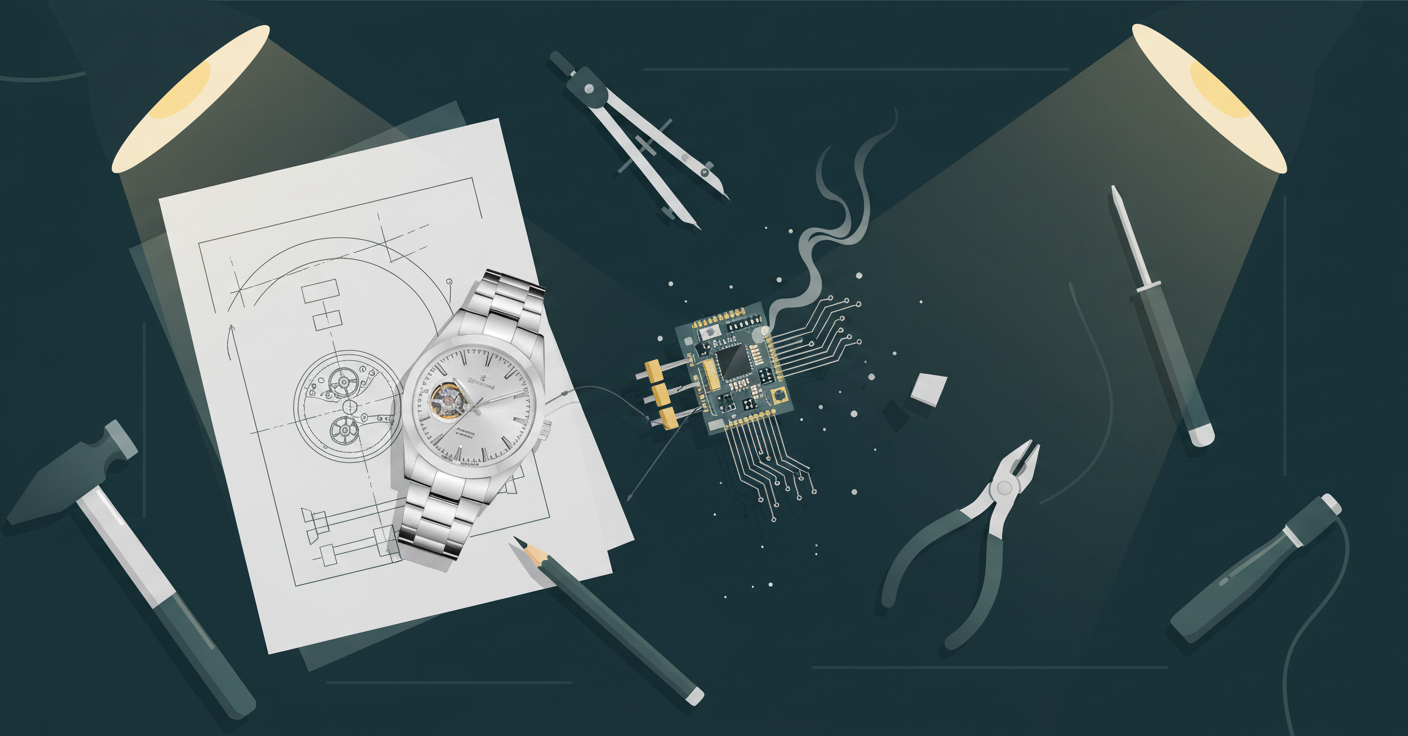
It’s 2 AM on a Tuesday. The final build is compiling. The CAD model is rendering. The last piece of the engine restoration just clicked into place. You lean back, the work done for now. You glance at your wrist for the time and see a cheap plastic band and a disposable digital display. It tells the time, but it says nothing about the hours you just invested. It’s an appliance. You build things that last. It’s time for a tool that does the same.
The decision to buy your first serious watch is a milestone. It’s a shift from disposable gadgets to permanent tools. It’s a declaration that you value engineering, longevity, and the deliberate focus of an analog instrument. Forget the marketing noise and the lifestyle gloss. This is a technical choice, and you are more than qualified to make it.
Your Checklist for a First Luxury Watch Under $1000
Navigating the world of watches can feel like decoding a secret language. But for a maker, it’s just a new set of specifications to master. To find the right first luxury watch under $1000, you don't need to be a connoisseur; you need a checklist. You need to know what matters, what doesn't, and how to spot genuine quality. This isn't about finding the most hyped brand. It's about finding the best-engineered object for your money.
Your evaluation should focus on four core areas. Get these right, and you will have a watch that serves you for decades. This is your framework:
- The Movement: The engine that drives the hands. Mechanical or quartz?
- Case Geometry: How it actually fits your wrist. Diameter is only half the story.
- Material Integrity: The tangible quality of the crystal, steel, and finish.
- Design Versatility: The strap-swap test for maximum utility.
We will break down each of these points. This is the practical, no-nonsense briefing for making an informed choice.
The Movement: Mechanical Heart or Quartz Precision?
The movement is the soul of the watch. For anyone who appreciates how things work, a mechanical movement is captivating. It’s a miniature, self-powered engine on your wrist, driven by a tightly coiled mainspring and regulated by a complex dance of gears, levers, and jewels. An automatic mechanical watch is powered by your own motion via a weighted rotor. It requires no batteries, no charging cables, and no software updates. It’s a sovereign piece of technology.
Many excellent Japanese workhorse movements, like the Seiko NH35 or the Miyota 9000 series, power watches well under the $1000 mark. They are robust, reliable, and can be serviced by any competent watchmaker. While enthusiast sites might push you towards entry-level Swiss options, the truth is you don't need to spend thousands to experience the satisfaction of a smoothly sweeping seconds hand. The goal is a reliable machine, not a status symbol.
Don’t discount quartz, either. A high-quality quartz movement is a model of efficiency and precision. It's more accurate, more shock-resistant, and requires less maintenance than a mechanical equivalent. For a this piece tool, it's an unimpeachable choice. The key is to distinguish between a cheap, disposable quartz module and a well-made one in a solidly constructed case. The choice isn't between good and bad, but between two different engineering philosophies. Choose the one that aligns with your purpose.
Case Geometry: Beyond the Diameter
Here is where most first-time buyers make a mistake. They focus only on case diameter. A 42mm watch isn't just a 42mm watch. The crucial measurement is the this piece distance—the total length of the case from the tip of the top lugs to the tip of the bottom ones. This dimension dictates how the watch spans your wrist.
A watch with a 42mm diameter but a compact 47mm this piece might wear smaller than a 40mm watch with a sprawling 50mm this piece. Before you buy, measure the flat top surface of your wrist. A 7-inch (18cm) wrist, for example, can typically accommodate a this piece of up to 50mm comfortably. Anything more, and the lugs will likely overhang your wrist, creating an awkward and unstable fit.
Case thickness also matters. A 14mm thick dive watch will have a commanding presence, while a 10mm thick dressier piece will slide easily under a cuff. Consider your daily environment. Do you need something robust and present, like our own 41mm automatic diver, or something more streamlined? The geometry of the object defines its function and feel.
The Litmus Test: Materials and Versatility
A great watch feels solid. The first non-negotiable is the crystal. Insist on sapphire. It is exceptionally scratch-resistant, which means your watch will look clear and new for years. Mineral or acrylic crystals, common on cheaper watches, will inevitably accumulate scratches and scuffs from daily wear. A sapphire crystal is a mark of a watch built for the long haul.
Next, look at the case finishing. Is it a uniform block of high-polish steel, or does it feature a sophisticated mix of brushed and polished surfaces? Good finishing—crisp lines between brushed and polished facets—is a sign of manufacturing care. It shows that the maker wasn't just building a case, but sculpting one.
Finally, assess its versatility. A truly great first watch is a chameleon. It should look just as right with a t-shirt and jeans in the workshop as it does with a jacket in a meeting. The ultimate test is strap compatibility. A watch with a standard lug width (like 20mm or 22mm) is a platform. On its steel bracelet, it's a tough tool. Swap to a leather strap, and it becomes more refined. Put it on a nylon NATO strap, and it's ready for a weekend of hard work. A watch like a classic field watch is a master of this, changing its entire character with a simple strap swap.
This adaptability is core to our philosophy. You contain multitudes. Your watch should keep up. If a watch only works with its proprietary integrated bracelet, it's a one-trick pony. A versatile design respects your dynamic life.
Building Your Legacy, One Second at a Time
You've reviewed the specs. You know what to look for in a movement, how to assess its real-world fit, and what materials signal true quality. Choosing your first serious watch isn't about joining a club. It is about acquiring a tool that reflects your own standards. It’s a piece of personal infrastructure. It’s a silent partner in your work, a witness to the hours of focus and dedication you pour into the things you build.
This discipline is something every The Inventor understands. It’s a commitment to getting the details right because you know that’s the only way to create something of value. For those who want to explore this topic further, we have assembled more guidance in our [comprehensive guide to your first luxury watch](/this piece). A watch like [[product: Men's Silver Watch S17064M|this skeleton dial automatic]] embodies this principle, putting its intricate mechanical engineering on full display. It doesn't just tell time. It demonstrates how time is kept. That is the difference between an appliance and an instrument.
About the author
Spectrum Editorial
The Spectrum Watches editorial desk
The Spectrum editorial desk — fact-checked, persona-mapped, and written for people who measure life in moments.
Wear the story