
how to set a chronograph watch with one dial analog
Master your analog chronograph by learning the function of each pusher and subdial to precisely measure elapsed time, from seconds to hours.
Spectrum Editorial · 7 min read · 24 views
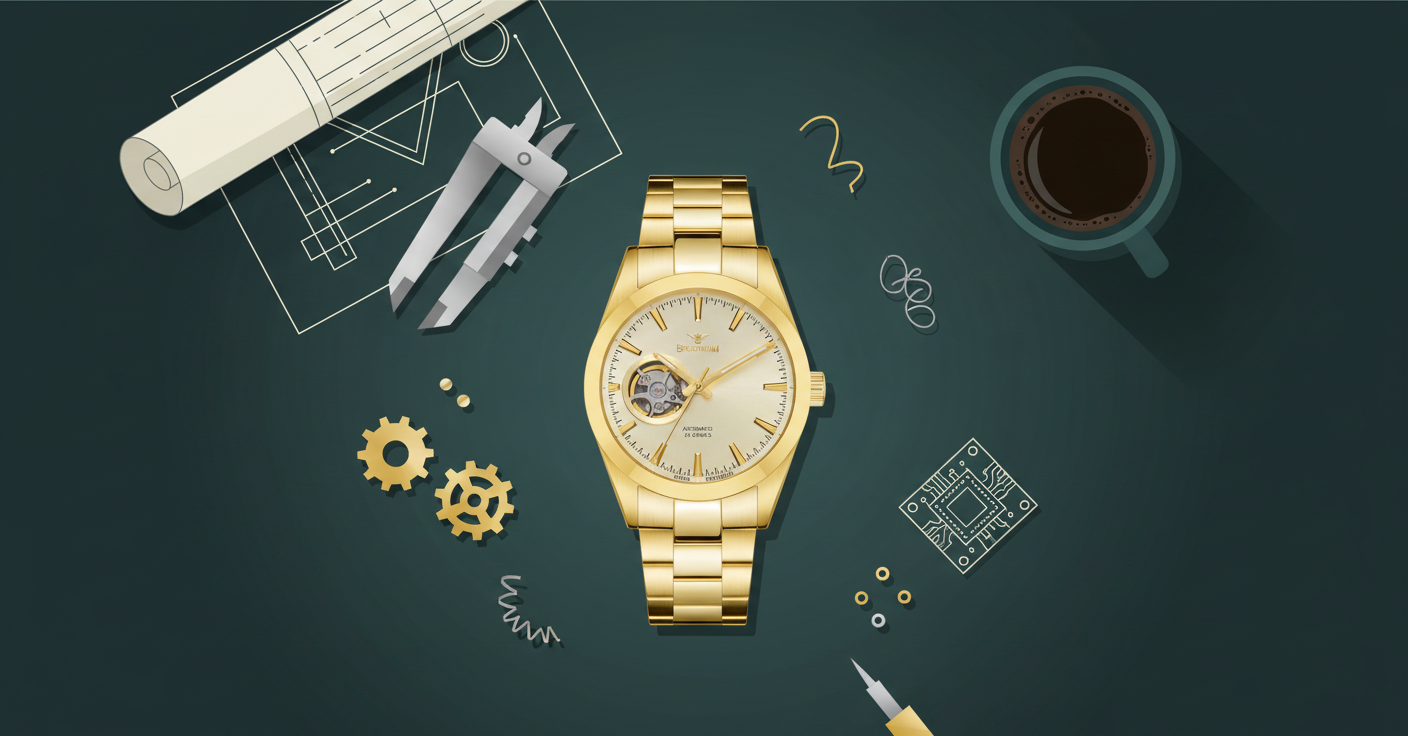
To set and operate a chronograph watch with one main dial, you use the pushers on the side of the case—typically, the top pusher starts and stops the timer, while the bottom pusher resets it to zero.
It’s 6 AM on a Saturday. The rest of the city is either still out or sleeping in. Your workshop is quiet, filled with the clean smell of machine oil and potential. The project is on the bench. Maybe it’s a circuit board you’re debugging, a piece of furniture in its final stages of assembly, or a custom engine build hitting a critical milestone. This is your time. It’s not about escaping the week; it’s about building what comes next. In these hours, every second is a unit of progress, a building block. You don’t need notifications or digital noise. You need focus. You need a tool that measures your effort without demanding your attention.
The chronograph on your wrist isn’t a passive observer. It’s an active participant in the work. It’s there to quantify a test, to time a chemical reaction, to hold you accountable to the constraints of the physical world. Understanding this instrument is the first step. Mastering it is part of the craft itself.
The Anatomy of a Chronograph
Before you can use it, you need to know the landscape. A chronograph looks complex, but it’s a model of mechanical efficiency. It adds a stopwatch function to a traditional analog watch without compromising the core task of telling time. Forget touchscreens and menus. This is a tactile, physical interface.
The main, large seconds hand on most chronographs is not for telling the current time. It sits, poised and waiting, at the 12 o’clock position. This is your stopwatch hand. The regular, continuous seconds are typically displayed on one of the smaller subdials on the watch face. This is often the first point of confusion for new owners, who expect the large hand to sweep continuously.
Your primary controls are the two pushers flanking the crown. The crown itself is for setting the time and date, as on any analog watch. The pushers are for the chronograph. The top pusher, located at 2 o’clock, is the start/stop button. One firm press brings the large seconds hand to life. A second press halts it instantly. The bottom pusher, at 4 o’clock, has one job: reset. It only works when the chronograph is stopped. Pressing it snaps the seconds hand and subdial counters back to their zero position.
Finally, look at the subdials. These are the registers that record elapsed time beyond 60 seconds. While layouts vary, a common configuration includes a 30-minute or 60-minute counter and a 12-hour counter. By reading these in combination, you can time an event with precision for hours on end. Some designs also feature a tachymeter scale on the bezel, a tool for calculating speed over a known distance, but the core function resides in the hands and subdials.
Your this piece Guide to Operation
Operating the chronograph is a simple sequence of physical actions. It’s a process that quickly becomes muscle memory, allowing you to measure the world around you without a second thought. The satisfying click of the pusher is the only feedback you need. Here is the universal sequence for nearly any analog chronograph.
- Set the Time: Before using the chronograph, ensure your watch is set to the correct time. Pull the crown out to its final position to adjust the hour and minute hands. Push it back in completely to start the watch. The small running seconds subdial should be in motion.
- Start Timing: Press the top pusher (2 o’clock) firmly. You will feel a crisp click as the mechanism engages. The large, central chronograph seconds hand will begin to move, sweeping around the dial once every minute. This is the start of your measurement.
- Read Elapsed Time: As the central seconds hand passes the 60-second mark, the minute subdial will advance by one increment. If you are timing a longer event, the hour subdial will likewise advance as 60 minutes are completed. To read the elapsed time, you first note the hours, then the minutes from the respective subdials, and finally the seconds from the main chronograph hand.
- Stop Timing: When your event is complete, press the same top pusher again. The central seconds hand and all active subdials will freeze in place, preserving the measurement. You can now read the final time with perfect clarity, without pressure.
- Reset to Zero: With the chronograph stopped, press the bottom pusher (4 o’clock). The central seconds hand and the minute and hour counters will all snap back to their starting position at 12 o’clock. The instrument is now ready for its next task.
Some advanced chronographs, known as “flyback” models, allow you to reset and restart the timer with a single push of the bottom button, but the standard operation remains the foundation for them all. It's a system perfected over a century, long before batteries or software existed.
Beyond Seconds: The Discipline of Measurement
Anyone can start a timer on their phone. That’s not the point. The act of using a mechanical or quartz chronograph is a statement of intent. It’s a choice for a dedicated tool over a digital multitool that does everything but excels at nothing. When you press that pusher, you are engaging with a piece of engineering designed for one purpose: to master intervals of time.
This is the same discipline that separates a casual hobby from a true craft. It’s the patience required to let epoxy cure for the full 12 hours, timed precisely. It’s the rigor of A/B testing two software builds and measuring the performance difference down to the second. For the person who builds, who creates, these measurements are not trivial. They are the data points that lead to perfection. They represent the boundary between guessing and knowing. The work of The Inventor is a series of questions answered by data, and time is often the most critical variable.
When you are restoring an engine, you need to time the firing order. When you are developing a new recipe, you need to know exactly how long the caramelization process takes. In these moments, you reach for a tool that is as serious as your work. [[product: Men's Silver Watch S17064M|This powerful automatic chronograph]] becomes an extension of your process, its subdials a silent ledger of your focused effort. Its mechanical movement is a reminder that complexity and reliability can be achieved through gears and springs, a testament to the same principles of ingenuity you apply in your own work. The visible mechanism of an open-hearted skeleton watch makes this connection even more explicit, showing the machine that measures the moments.
Analog Intentionality in a Digital World
We live in an age of digital saturation. Our devices buzz, beep, and vibrate, pulling our attention in a thousand directions. They track our heartbeats, our steps, our sleep patterns—a constant stream of data that promises optimization but often delivers distraction. A smartwatch is a window to the internet on your wrist. An analog chronograph is a shield against it.
Choosing an analog timepiece is a deliberate act of disconnection. It’s a decision to own a tool that respects your focus. It will not interrupt your train of thought to tell you about an email or a social media mention. Its function is pure, its interface tactile and unambiguous. This is not an oversight; it is the entire point. While a smartwatch offers a universe of features, it also brings a universe of interruptions. It's a fundamental trade-off: capability versus concentration. For deep work, the choice is clear.
This isn't about rejecting technology. It's about choosing the right technology for the task. The same person who writes elegant code on a this piece computer can appreciate the single-minded purpose of an analog instrument. It’s the same reason a master woodworker uses a hand plane instead of a power sander for the final finish, or why a chef uses a whetstone instead of a pull-through sharpener. It’s about control, feel, and an intimate connection with the process. Sometimes, the most advanced tool is the one that does less, more intentionally. Even a simpler dress piece without a timer embodies this principle of singular focus.
Your watch tells you the time. If it’s a chronograph, it helps you measure time. That is all. It leaves the rest to you. It is a silent partner in your work, a testament to the hours you invest. It trusts you to know what to do with the time it keeps. Who are you today? You are the one who builds, who measures, who finishes the job. And you have the right tool for it.
About the author
Spectrum Editorial
The Spectrum Watches editorial desk
The Spectrum editorial desk — fact-checked, persona-mapped, and written for people who measure life in moments.
Wear the story