
A Diwali Watch for the Workshop Maker: Built for the Bench
For engineers and builders refining hardware past midnight, discover why an unyielding, screen-free quartz timepiece belongs on your workshop bench this Diwali.
Spectrum Editorial · 7 min read · 9 views
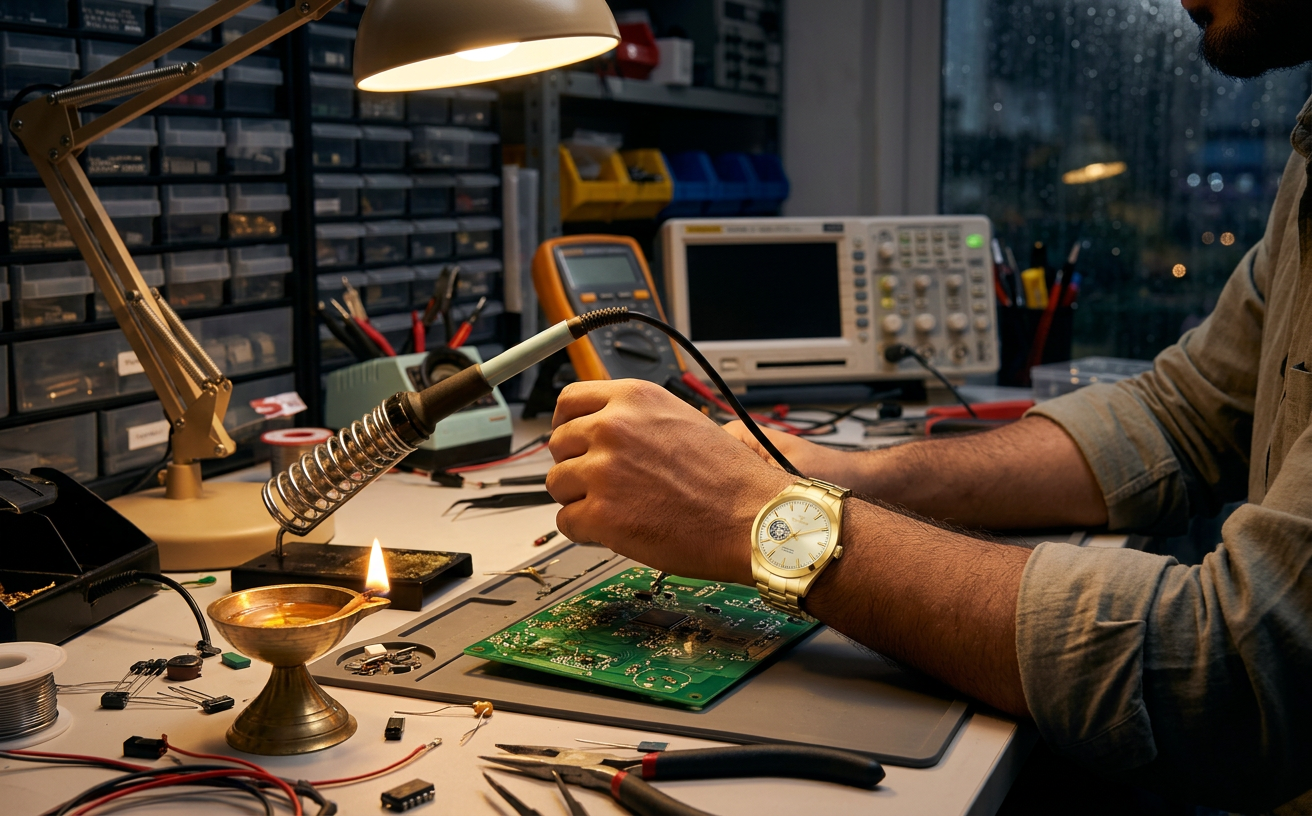
The floor of the garage workshop in Bengaluru smells of isopropyl alcohol, cut brass, and burnt flux. Outside on the street, the lingering smoke of Dhanteras and Diwali firecrackers still hangs in the humid November air, but inside the bay, the only sound is the rhythmic hiss of a hot soldering pencil and the cooling fan of an oscilloscope. You have spent the better part of three days chasing a parasitic power draw on a custom battery management board. It is four in the morning. Your phone is face down on a shelf across the room because notification pings shatter the cognitive tunnel required to isolate a faulty surface-mount capacitor. At this hour, hunting for a dedicated diwali watch for the workshop maker is not about jewelry or celebratory status. It is about equipping your wrist with an instrument that respects physical work.
A maker’s bench is a harsh environment. It is a world of ferrous shavings from the drill press, electromagnetic fields from high-current switching power supplies, and accidental impacts against the cast-iron jaws of an engineer’s vise. You do not wear delicate complications here. You wear tools designed to take a hit, hold time without drift, and tell you precisely how many hours remain before the morning courier arrives.
Choosing a Diwali Watch for the Workshop Maker
When you build physical hardware, you quickly learn that complexity is the enemy of reliability. Every extra component introduces a potential shear plane or solder failure. That principle extends directly to wristwear. A proper diwali watch for the workshop maker must satisfy three non-negotiable criteria: it must resist magnetic interference, survive solvent splashes, and remain completely legible through tinted safety goggles.
Many colleagues browsing the market get pulled into the traditional automatic enthusiast trap, debating whether an entry-level mechanical field watch or a classic Seiko 5 alternative can survive the shop floor. While mechanical escapements possess romantic heritage, a heavy magnetic chuck on a surface grinder or the unshielded coils of an industrial CNC spindle will magnetize an unshielded hairspring in seconds. Once magnetized, a mechanical watch gains twenty minutes a day and demands a demagnetizer. In contrast, an analogue quartz movement housed in solid stainless steel simply shrugs off high-gauss environments. It continues pulsing forward with unyielding single-second accuracy, indifferent to nearby induction heaters or heavy transformer banks.
At the same time, the this piece fashion watch boom has flooded social feeds with disposable pieces. The generic DW and MVMT tier relies on lightweight zinc-alloy cases coated in thin decorative lacquer that bubbles and peels the moment it encounters acetone, mineral spirits, or brake cleaner. True makers see right through hollow marketing. Since 1990, Spectrum has engineered timepieces in Dubai designed with solid 316L stainless steel casings, mineral crystals, and dependable Japanese quartz movements backed by a two-year international warranty. These are watches built directly for those who manipulate metal, code firmware, and turn wrenches.
The Anatomy of the Build: Constraints and Prototypes
Every project begins with brutal constraints. Consider the build cycle of an autonomous sensor node destined for an agricultural deployment outside Pune. The initial specification sheet always looks deceptively simple: sample soil moisture every ten minutes, transmit over a long-range sub-gigahertz radio, and survive two monsoon seasons on a single sealed battery cell.
Then comes version one. You breadboard the circuit using this piece development boards and jumper wires that look like a nest of multicolored spaghetti. The firmware functions in the comfort of an air-conditioned lab, but the moment you test the rig inside a thermal chamber, the voltage regulator overheats and the radio brownouts. The clock on your wrist is the only constant as the night bleeds into dawn. For this level of sustained concentration, The Inventor requires zero digital noise. You do not want a wrist screen buzzing to inform you about an unread email or an app update when your hands are steadying a hot-air rework station to reseat a this piece millimeter pitch microchip.
During long debugging sessions, the [[product: Men's Silver Watch S17064M|gold-plated stainless steel S17064M]] serves as a deliberate counterweight to utilitarian grime. Its brushed and polished gold-tone steel links wrap securely around the wrist with a deployment clasp that never snags on workbench grounding straps. At two hundred and ninety dollars, it is not an untouchable safe-queen; it is a durable steel instrument finished with lustrous ion plating that catches the overhead fluorescent lighting every time you reach for an Allen key or rotate a rotary encoder.
The Rework: Where Integrity Is Tested
No prototype survives first contact with reality without a comprehensive rework. The second phase of making is where most hobbyists quit and true builders dig in. You redesign the printed circuit board in your CAD suite, laying out wider ground planes and rerouting high-frequency differential traces to kill inductive noise. You order copper-clad boards, wait for the delivery truck from Delhi, and set up your chemical etching tank or desktop PCB milling machine.
Here are the physical realities every workshop maker balances on the bench:
- Thermal Management: Keeping heat-sinking planes large enough to dissipate power without making the board impossible to hand-solder.
- Mechanical Tolerances: Ensuring clearance for aluminum enclosure standoffs without pinching delicate ribbon cables.
- Power Optimization: Stripping away every unnecessary LED indicator to drop quiescent sleep current to single-digit microamps.
- Material Selection: Choosing anodized 6061 aluminum over cheap 3D-printed filaments for housings exposed to UV and moisture.
When you are cutting custom faceplates on a manual lathe, chips of hot metal fly across the tool rest. If you prefer a more subdued aesthetic on your wrist while working the chuck, the brushed silver daily reference delivers an all-steel exterior that blends seamlessly with industrial machinery. Like the rest of Spectrum's catalog, it skips delicate decorative frills in favor of solid machining and crisp, high-contrast dial markings.
The Day It Ships: From Industrial Dust to Festive Lights
In India, Diwali marks the traditional opening of new financial books, the blessing of tools during Vishwakarma Puja, and the start of a fresh operating cycle. In workshops across Mumbai, Hyderabad, and Chennai, mechanics clean their micrometers, carpenters hone their chisels, and hardware engineers wipe down their anti-static mats. Shipping a hardware build right after Diwali brings an unmatched sense of closure.
You box the completed, conformal-coated nodes, seal the weatherproof enclosures, label the crates, and watch the logistics van pull away into morning traffic. The frantic pace of problem-solving suddenly subsides. You clean the bench. You store the spools of lead-free solder, sweep away the curly aluminum chips, and wash the machine oil from your palms.
This transition from maker to celebrant is where a well-built steel watch proves its versatility. A timepiece engineered from high-grade stainless steel looks just as natural resting on a workbench alongside digital calipers as it does paired with a crisp linen kurta for a post-Diwali family gathering. When selecting engineered gifts for teammates who live in maker spaces and machine shops, you look for objects that celebrate substance over superficial hype. A quartz watch built from solid metal honors the recipient’s work ethic because it was constructed with the same manufacturing discipline they apply to their own craft.
The Discipline of Simple Mechanics
There is a common misconception that makers only care about software code or bleeding-edge silicon. But spend an hour talking to anyone restoring a vintage motorcycle engine in Delhi or machining bespoke camera mounts in Mumbai, and you will discover a profound respect for fundamental physics. They appreciate the tension of a spring, the tooth engagement of brass gears, and the dependable piezoelectric oscillation of a quartz crystal cut to exactly 32,768 hertz.
A Spectrum analogue watch does not try to be a computer. It does not demand a nightly firmware download, it does not send telemetry to remote corporate servers, and it will never render itself obsolete because an operating system discontinued support for its chipset. It carries a battery that runs quietly for years, turning quartz resonance into precise physical movement. That functional clarity resonates with people who construct tangible objects. When you strip away the digital clutter, what remains is an instrument of quiet accountability.
As the festival of lights concludes and another year of challenging builds commences, take pride in the scratches on your workbench and the callus on your thumb. Wear a watch that reflects the hours of unglamorous engineering that made the final product possible. You do not need hollow luxury to validate your progress. You simply need reliable tools, clean tolerances, and a timepiece that keeps pace with your ambition.
About the author
Spectrum Editorial
The Spectrum Watches editorial desk
The Spectrum editorial desk — fact-checked, persona-mapped, and written for people who measure life in moments.
Wear the story