
What is a GMT watch?
A GMT watch is a timepiece that displays two time zones at once, typically using an additional 24-hour hand and a corresponding 24-hour bezel.
Spectrum Editorial · 7 min read

A GMT watch is an analog timepiece capable of displaying two time zones simultaneously, using a fourth hand that makes one full rotation every 24 hours.
It’s 4 AM. Your headlamp cuts a clean circle on the gear spread across your floor. Boots, check. Pack, check. The route is locked in your head, but your focus is split. Half of you is here, preparing for the pre-dawn drive to the trailhead. The other half is nine hours ahead, visualizing a rope-partner’s progress on a different continent entirely. You're making a calculated choice to go where your phone won't work, but coordination is everything. This is the modern adventurer's paradox: disconnected execution, connected planning.
This exact problem—managing time across distances—is what drove the creation of one of horology's most practical tools. It’s a complication built not for status, but for logistics. It’s for people whose lives and work don't fit neatly into a single time zone. People who understand that true self-reliance sometimes means knowing exactly what time it is somewhere else.
The 90-Second Guide to Reading a GMT
Forget the dense forum threads and encyclopedic entries. The concept is simpler than you think. A GMT watch adds one key piece of information to a standard analog dial: a second time zone. It achieves this with two primary components working together.
First, there's the GMT hand. This is the fourth hand on the dial, often tipped with a distinct arrow or triangle and rendered in a contrasting color. While the main hour hand circles the dial twice per day (12 hours per rotation), the GMT hand circles only once. It points to a 24-hour scale, giving you an unambiguous reading of the hour in the second time zone. No AM/PM confusion. 14:00 is 2 PM, period.
Second, there's the 24-hour scale itself. On most GMT watches, this scale is printed or engraved on a rotating bezel that frames the dial. This is where the genius of the design comes into play. By rotating the bezel, you can offset the 24-hour scale relative to the GMT hand, allowing you to track a third time zone if needed, or simply to adjust your reference time on the fly.
Here’s how you use it in practice:
- Set Your Home Time: You typically set the GMT hand to your home time zone against the 24-hour bezel. For instance, if it's 8 PM (20:00) at home, you point the GMT hand to the '20' on the bezel. This hand now becomes your constant—your anchor to home base.
- Set Your Local Time: You then set the main 12-hour hands (the ones you're used to) to the local time wherever you are. If you've just landed in Chamonix from Colorado, you'd set the main hands to Chamonix time.
- Read at a Glance: Now, your watch tells you everything. The main hands show local time for the bar you're in. A quick glance at the fourth hand tells you it’s the middle of the morning back home, so it's a good time to send that check-in text before you go dark in the mountains.
That’s it. It’s a simple, mechanical computer on your wrist designed for one specific, crucial task. It was born in the golden age of air travel for Pan Am pilots but has since been adopted by anyone whose plans are bigger than their immediate location.
More Than a Pilot's Toy
The GMT complication is often associated with high-end luxury, sold with images of pilots in crisp uniforms and executives in airport lounges. But to view it solely as a status symbol is to miss its raw utility. For an Explorer, its function is far more grounded. It's a tool for managing the complex, unglamorous logistics that make real adventure possible.
Think of the overland expedition leader coordinating a resupply drop with a team in a different country. Or the marine biologist on a research vessel in the Pacific, needing to align data logs with the university's servers back in Europe. Or even the mountaineer acclimatizing at base camp, who needs to know the optimal window to call their weather routing service in Boulder. In these scenarios, the GMT isn't about luxury; it's about precision and safety.
This function decouples you from reliance on a digital screen. It’s for moments when you can't be pulling out a fragile phone, unlocking it, and swiping to a world clock app. A glance at the wrist is faster, more secure, and keeps you present in your environment. It’s a testament to the idea that the right tool should reduce cognitive load, not add to it with notifications and distractions. It lets you keep your head in the game, whether you're navigating a foreign city or a technical ridgeline.
The Case for Analog When You're Off-Grid
While a true GMT is a specialized instrument, its core spirit is about something broader: the power of a self-sufficient, analog timepiece. Let's be honest—most of us can do the time zone math in our heads. The real value isn't just about avoiding arithmetic; it's about choosing your tools with intention.
A smartwatch dies. Its screen is a point of failure. It demands a charging cable, a power bank, and a connection to a network that simply doesn't exist where you're going. It pulls you out of the moment with vibrations and alerts that have no place on a summit push or a quiet paddle across a glacial lake. A traditional analog watch—whether a quartz or an automatic—is the antithesis of this. It's a closed system, powered by a battery that lasts for years or by the movement of your own body.
Its function is pure. It tells the time. That's it. This singular focus is not a limitation; it's a strength. For many trips, a tough, legible, and water-resistant watch is the perfect companion, providing the critical information you need without the digital noise. Even without a fourth hand, a reliable analog watch is a declaration of independence. It's your personal time standard, a piece of gear that works for you and asks for nothing in return. A piece like [[product: Men's Two Tone Gold Watch S17072M|this rugged two-tone automatic]] is built for exactly that context—field-ready and free from screens.
Choosing Your Timekeeper
Whether you decide the specialized function of a GMT is essential, or a classic three-hand watch is more your speed, the criteria remain the same for an adventure-ready piece. You're not buying jewelry. You're selecting a piece of gear as critical as your compass or water filter.
First, consider legibility. In low light or at a quick glance, you need to be able to read the time without a second thought. High-contrast dials, clear markers, and luminous hands are non-negotiable. While some designs are complex, a watch like [[product: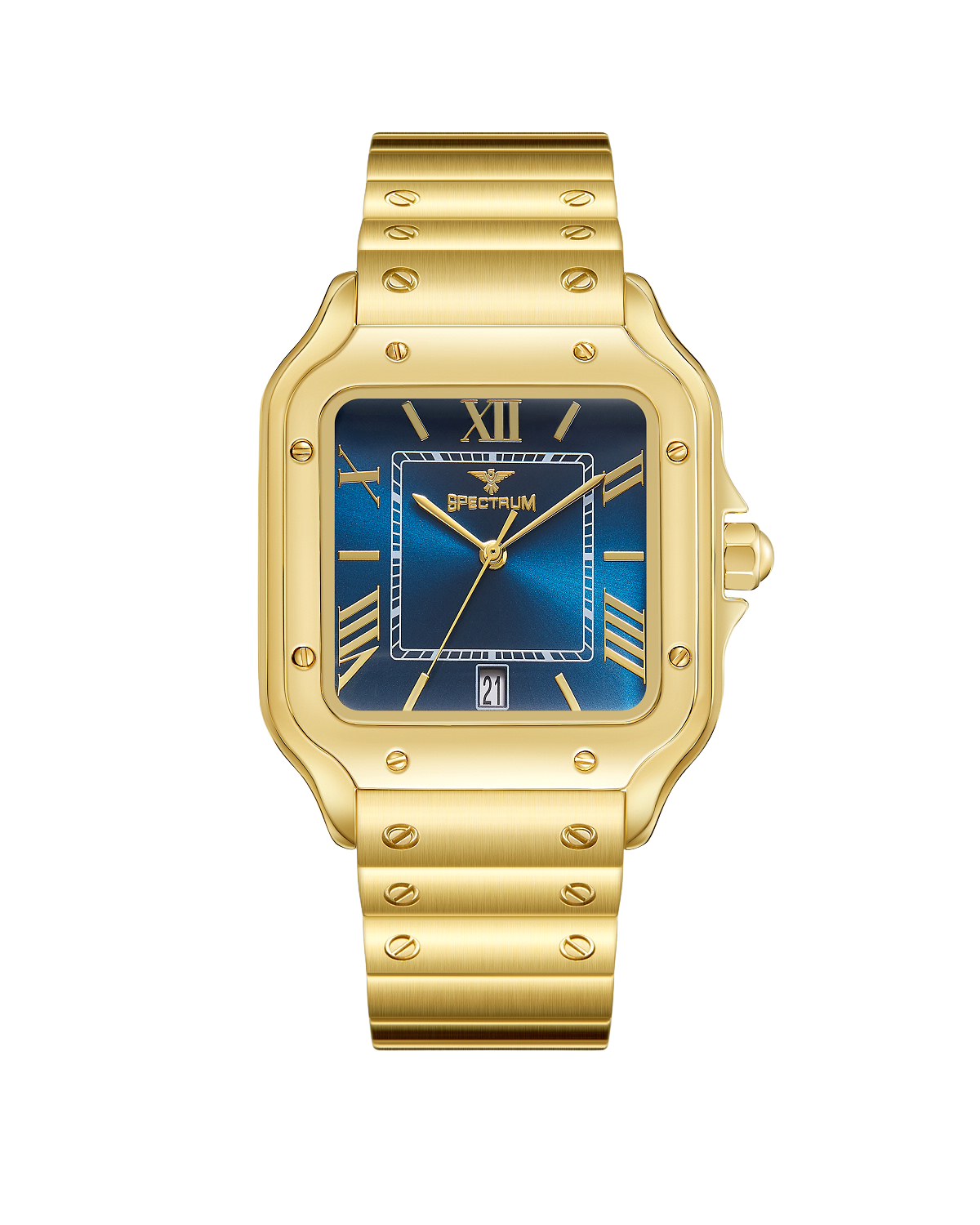 Men's Silver Watch S17051M|a clean silver-dial model]] prioritizes instant readability.
Next, evaluate durability. A stainless steel case provides a baseline of toughness and corrosion resistance. Look for a protected crown and a crystal that can withstand the inevitable bumps and scrapes of active use. Water resistance is also key, not just for diving but for unexpected river crossings, downpours, or just washing off the day's grime.
Finally, think about how it works. A quartz movement offers this piece reliability and accuracy, running on a battery for years at a time. An automatic (self-winding) mechanical movement offers a different kind of self-sufficiency, powered by your own motion with no battery to ever replace. Choosing between them is a personal preference, a trade-off between this piece convenience and the intricate, perpetual craft of a mechanical engine. Pieces like [[product: Men's Two Tone Gold Watch S17074M|another durable two-tone option]] deliver that mechanical soul.
Ultimately, a watch is a statement about how you choose to move through the world. It can be a connection to a digital hive mind, or it can be a tool of analog independence. For those who seek new ground, the choice is clear.
About the author
Spectrum Editorial
The Spectrum Watches editorial desk
The Spectrum editorial desk — fact-checked, persona-mapped, and written for people who measure life in moments.
