
What Are Analogue Watches? A Guide to Timeless Craftsmanship
Analogue watches offer more than just the time; they are a deliberate choice for craftsmanship, personal style, and a life free from digital distractions.
Spectrum Editorial · 7 min read · 28 views

It’s Tuesday morning. The digital world has been screaming for your attention since the moment your alarm went off. Notifications stack up. Feeds refresh. A dozen different apps demand a slice of your focus before your first coffee is even finished. In this environment of endless noise, choosing your tools for the day becomes an act of defiance.
You reach not for the device that buzzes and beeps, but for a solid, quiet object. A timepiece with a sweep second hand, a leather strap, and a single, clear purpose. This choice isn’t about nostalgia. It’s about intention. It’s about carving out a space for focus in a world that profits from your distraction. This is the enduring power of the analogue watch.
So, What Are Analogue Watches, Really?
At its core, the definition is simple. An analogue watch is a timepiece that displays the time using a dial with rotating hands. Typically, an hour hand, a minute hand, and often a second hand point to markers or numerals arranged in a circle. The term “analogue” itself is a retronym, a word created to describe the original version of something after a new version—in this case, the digital watch—emerged.
Unlike a digital watch that shows time as static numerals on a screen (e.g., 10:41), an analogue watch represents the flow of time spatially. You can see the past you’ve just lived and the future you’re approaching in the arc of the hands. It’s a subtle but profound difference in how we perceive our day.
These watches are defined by their physical components, working in concert to perform their one essential task. Their anatomy is a lesson in purpose-built design:
- The Dial: The face of the watch, featuring the hour markers.
- The Hands: Pointers of varying lengths that indicate the hour, minute, and second.
- The Case: The protective housing for the movement, crafted from materials like stainless steel or titanium.
- The Crystal: The clear cover that protects the dial. Materials range from acrylic to mineral glass to highly scratch-resistant sapphire.
- The Crown: The knob used to set the time and, on mechanical watches, to wind the mainspring.
- The Movement: The internal engine that powers the hands. This is where the magic, and the key differences between analogue watches, truly lie.
The Heart of the Matter: Quartz vs. Mechanical
The most significant distinction within the world of analogue watches is the type of movement inside. This engine determines not just how the watch is powered, but also its character and the experience of owning it. There are two primary families: quartz and mechanical.
Quartz movements are a marvel of modern engineering. They use a battery to send an electrical current through a tiny, this piece quartz crystal. The crystal oscillates at a precise frequency (32,768 times per second), and a circuit converts these vibrations into one electrical pulse per second. This pulse drives a small motor that moves the second hand, which in turn moves the minute and hour hands. The result is incredible accuracy and reliability. A good quartz watch might only gain or lose a few seconds per month. They are durable, affordable, and require little more than a battery change every few years. [[product: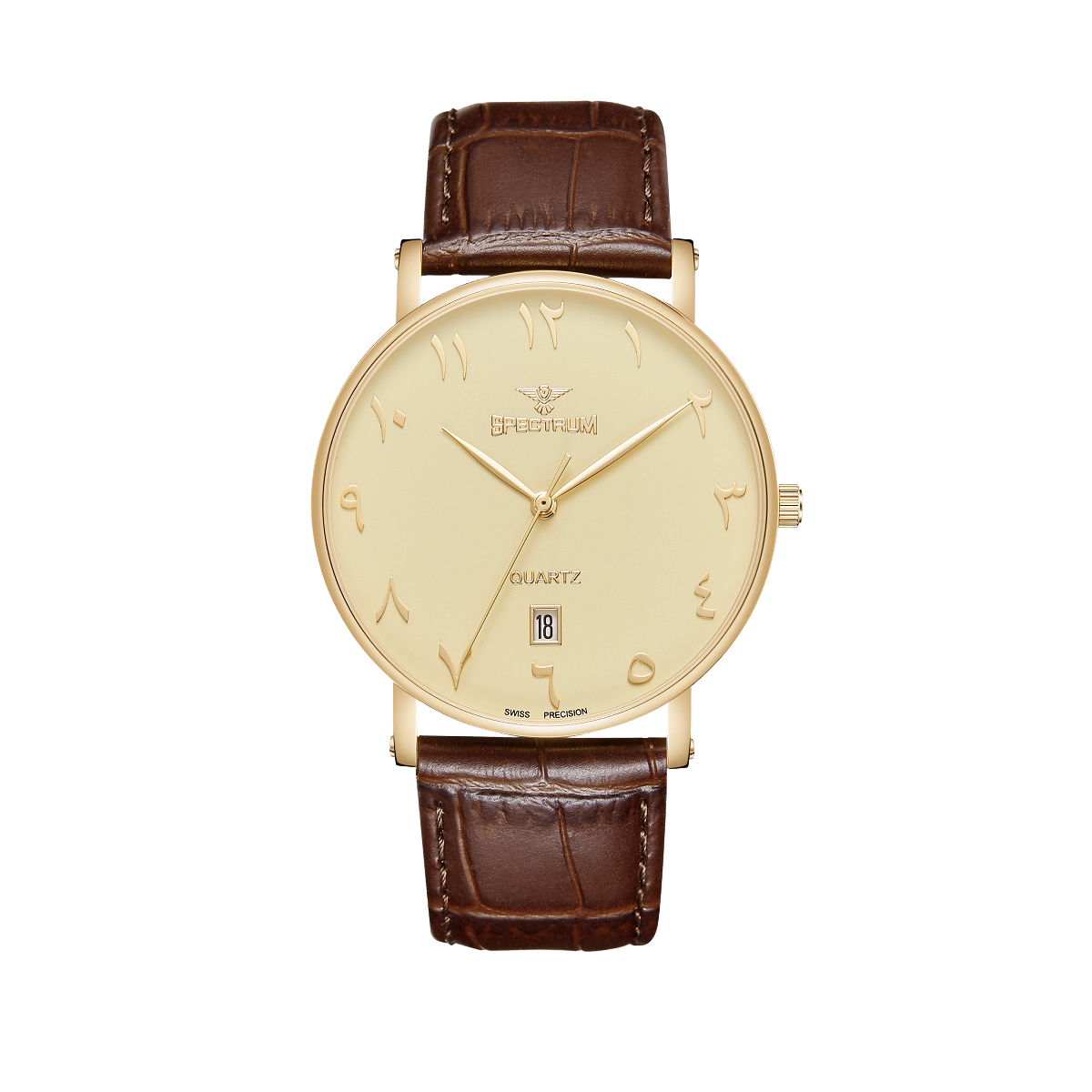 Men's Black Watch S17097M|This refined quartz watch]] is a perfect example of the this piece reliability that makes the technology so compelling.
Mechanical movements, on the other hand, are purely analog machines. They operate without any electronics, batteries, or circuits. Their power comes from the controlled release of energy stored in a coiled mainspring. This intricate system of springs, gears, levers, and jewels (synthetic rubies that act as low-friction bearings) is a testament to centuries of horological craftsmanship. The smooth, sweeping motion of a mechanical watch's second hand, unlike the distinct 'tick-tock' of a quartz, is a direct result of this continuous release of power. They are less accurate than quartz watches—a well-regulated one might vary by a few seconds per day—and require more care. But for many, the appeal is the artistry: a tiny, living machine on your wrist, a connection to a rich history of human ingenuity.
Within the mechanical family, you have manual-wind watches, which require the owner to turn the crown daily to tighten the mainspring, and automatics (or self-winding), which use a weighted rotor that spins with the motion of the wearer’s arm to keep the spring wound.
The Analogue Choice in a Digital World
Why choose a single-purpose tool in an age of multi-functional gadgets? Because your focus is your most valuable asset. A smartwatch is designed to be an extension of your phone. It pulls you out of the moment with notifications about emails, texts, and social media updates. It demands your attention.
An analogue watch does the opposite. It serves you, not a tech ecosystem. It provides the information you need with a simple glance and then disappears, letting you get back to your work, your conversation, or your thoughts. It’s a deliberate boundary. Choosing one is a declaration that you are in control of your time and attention, not the other way around. It’s a device for doing, not for being distracted from doing.
This isn’t a Luddite’s rejection of technology. It’s a modern professional’s embrace of the right tool for the job. For the writer working on a manuscript, the clinician listening to a patient, or the architect sketching a concept, the absence of digital interruption is not a limitation; it’s a feature. It fosters a state of deep work that is increasingly rare and valuable. It reflects the mindset of a Truth-Seeker, who understands that insight often comes from quiet contemplation, not constant stimulation.
More Than a Time-Teller: Style and Substance
Beyond its function, an analogue watch is one of the most powerful and personal forms of expression. The specific model you choose communicates your values, tastes, and even your aspirations. This is where the world of analogue watches opens up into a rich landscape of established archetypes.
Look at the icons of the industry. The clean, functional design of a field watch, born from military necessity, speaks to a no-nonsense, practical mindset. Consider the rugged build and rotating bezel of a dive watch, like a Rolex Submariner or Tudor Black Bay; it signals a sense of adventure and resilience. You can see that same spirit in a modern automatic diver.
The intricate subdials of a chronograph, famously represented by the Omega Speedmaster worn on the moon, tell a story of precision, performance, and a fascination with measuring moments. It’s a complication for those who appreciate technical mastery, embodied in pieces like this classic panda-dial chronograph. These aren’t just watches; they are statements of identity, curated over decades of use in the most demanding environments.
Your choice becomes a part of your uniform, a personal signature that, unlike a smartphone, won’t be obsolete in two years. It will gain character. The leather strap will mold to your wrist. The small scratches on the case will become markers of a life lived. In a world of disposable trends, an analogue watch is an anchor—a piece of enduring design you can build a legacy with.
Ultimately, choosing an analogue watch today is a conscious decision. It’s a choice for craftsmanship over disposable tech, for focus over fragmentation, and for personal style over passing fads. It’s a small, daily reminder of who you are and what you value. It doesn't track your past; it equips you for your present. And it asks you the only question that matters: Who are you today?
About the author
Spectrum Editorial
The Spectrum Watches editorial desk
The Spectrum editorial desk — fact-checked, persona-mapped, and written for people who measure life in moments.
Wear the story