Quartz vs Automatic: Which Movement Should You Wear?
Battery-precise or mechanically alive — the real difference between quartz and automatic watches, and how to pick the one that fits how you actually live.
Spectrum Editorial · 6 min read · 96 views
Quartz or automatic. One runs on a battery and a vibrating crystal. The other runs on your wrist. Both keep time. Neither is objectively better. The right one is the one that matches how you actually live — not what a forum told you to buy.
Here's the short version. Quartz is accurate to within about 15 seconds a month, needs a battery every two to three years, and does not care if you leave it in a drawer for six months. Automatic is accurate to within about 15 seconds a day, winds itself from the motion of your wrist, and stops if you stop wearing it. Everything else is nuance.
How each movement actually works
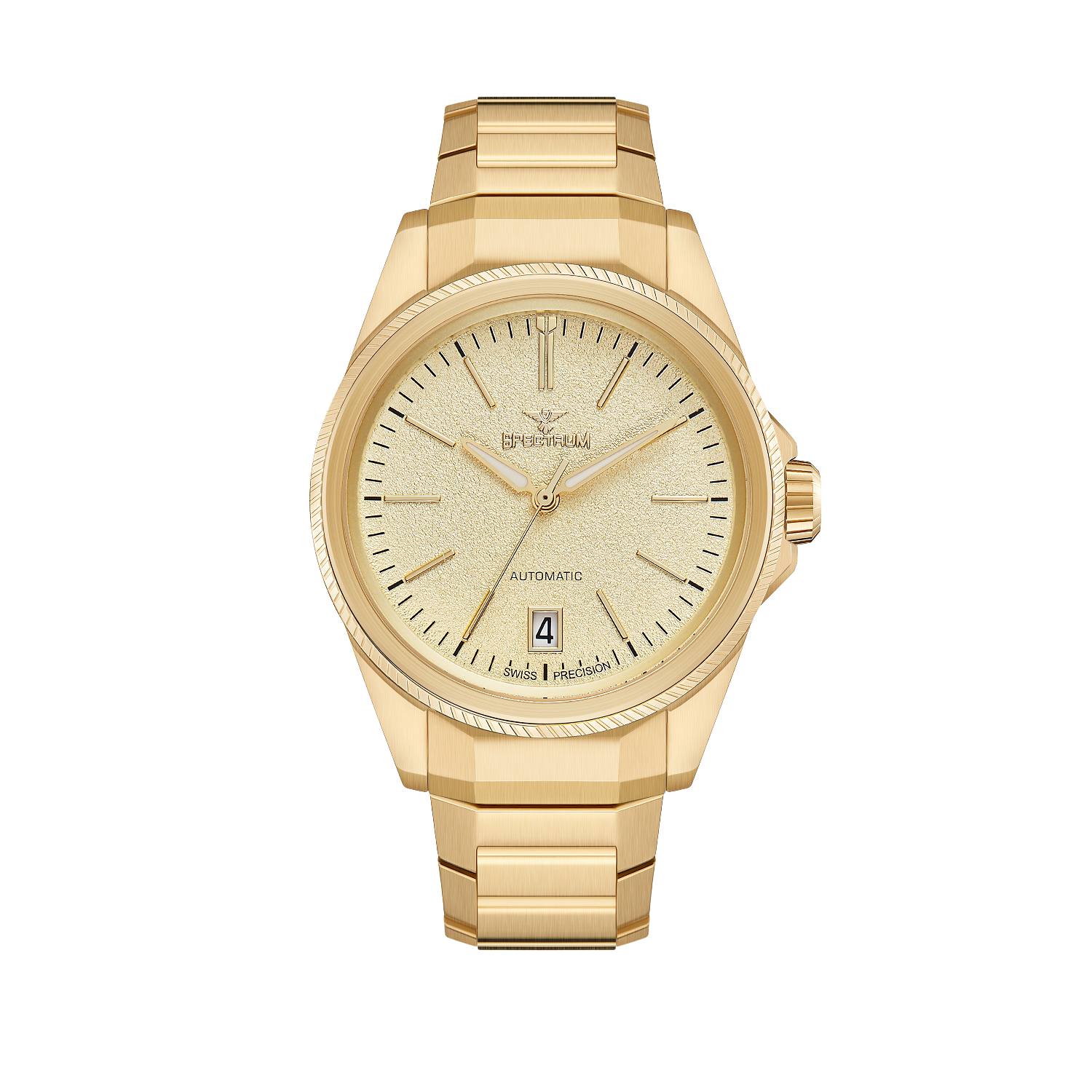
A quartz movement runs a small current from a battery through a tiny quartz crystal. The crystal vibrates 32,768 times per second — an almost boring level of precision. A circuit counts the vibrations and pulses the second hand once a second. That tick you hear is the vibration being translated into motion.
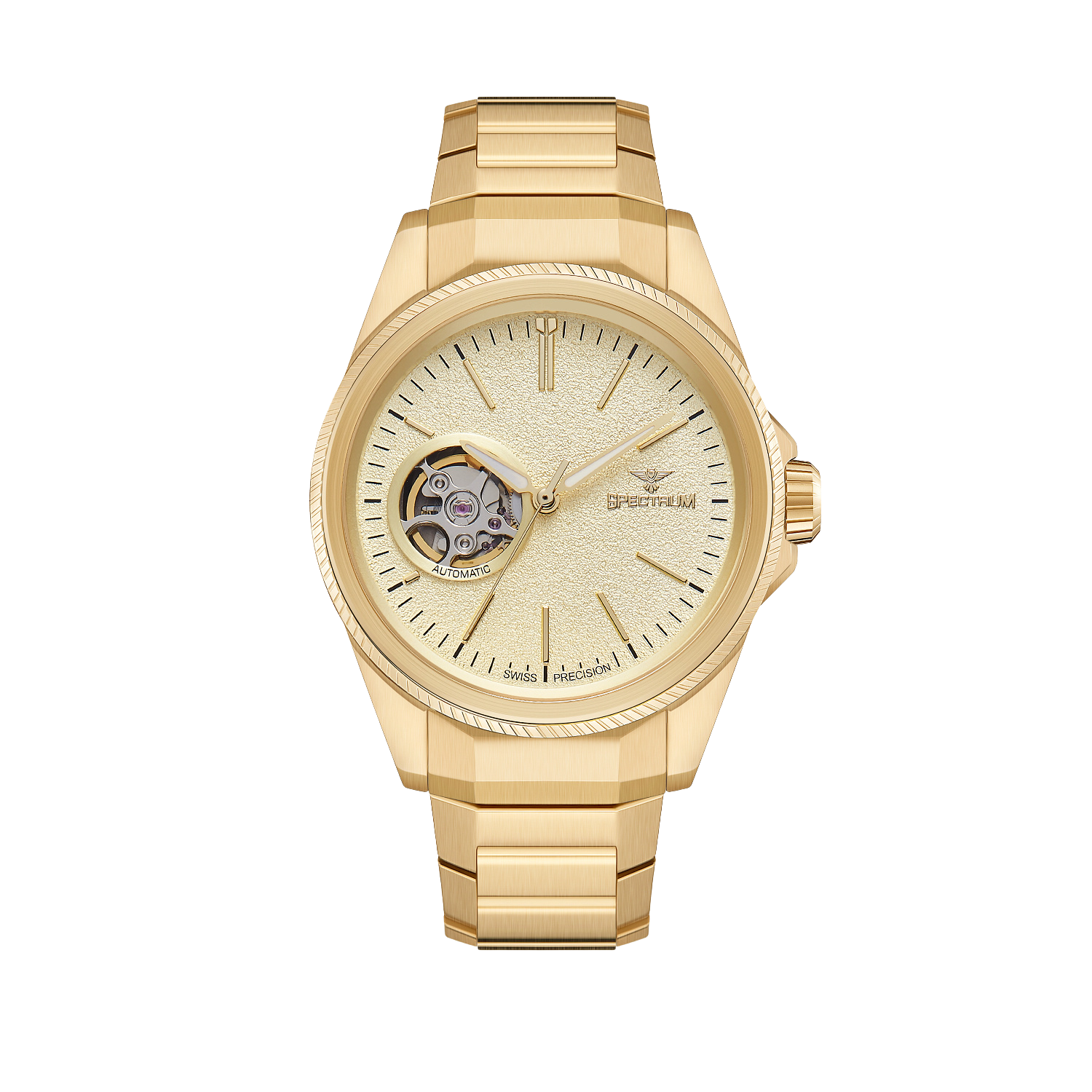
An automatic movement is a mechanical orchestra. A mainspring stores energy. A balance wheel oscillates back and forth roughly six to eight times a second. A rotor on the back of the movement swings with the motion of your arm and winds the mainspring as you go about your day. No battery. No circuit. Just physics and about 150 parts working in sequence.
Accuracy — the honest numbers
Quartz wins on paper. A standard quartz movement drifts about 15 seconds a month. A good automatic drifts about 15 seconds a day. That sounds dramatic until you remember most people check the time on their phone, then glance at the watch to feel something.
If you need the time to be right to the second — pilots, surgeons, anyone timing something that matters — quartz is the answer. If "close enough, and it's still ticking twenty years from now" is the answer, an automatic will happily do that.
Maintenance — what you're actually signing up for
Quartz needs a battery swap every two to three years. Any competent watchmaker can do it in ten minutes. That's the entire maintenance schedule.
Automatic needs a full service every five to seven years — the movement is disassembled, cleaned, lubricated, reassembled, regulated. It costs more than a battery. It also means the same watch can outlive you, then your kid, then keep going.
Living with each one
Wear an automatic every day and it stays wound. Take it off for a weekend and it will stop. You'll reset the time and the date on Monday. This is not a flaw. It's the price of admission for a watch that is mechanically alive on your wrist.
Wear a quartz however you want. Rotate three watches, leave one in a drawer for a year, pick it up on a Tuesday — it will be running, and it will be right. No winding, no resetting, no ritual.
Which one fits which life
Quartz is the answer if you rotate multiple watches, travel constantly across time zones, need dead-accurate timing, want the thinnest possible profile, or simply don't want a watch to demand anything of you. Most travel watches, most sports watches, and most first watches are quartz for exactly this reason.
Automatic is the answer if you like the idea of an object that responds to you — that literally runs on your motion. If you enjoy the ritual of winding a watch on a Monday morning. If you want something to hand down. If the fact that there is no battery, no chip, no software feels like a small, quiet rebellion against everything else on your wrist.
The Spectrum position
We build both. Our quartz pieces are for people who want their watch to disappear into their life — always running, always right, never a chore. Our automatic pieces are for people who want their watch to be a small, mechanical companion — one that ticks because they moved, and stops when they stop.
Neither is more "serious" than the other. A well-made quartz watch on a considered dial will outlast most of the smartwatches sold this year. A well-made automatic will outlast the person wearing it. What matters is that the watch you strap on tomorrow morning fits the version of you that's wearing it.
The one-line answer
Choose quartz if you want a watch that never asks anything of you. Choose automatic if you want a watch that only lives when you do.
About the author
Spectrum Editorial
The Spectrum Watches editorial desk
The Spectrum editorial desk — fact-checked, persona-mapped, and written for people who measure life in moments.